
Insulation monitoring devices PMIC type for DC electric vehicle charging stations
LOVATO Electric is expanding its range of solutions for e-mobility with new PMIC type insulation monitoring devices (IMDs) for DC electric vehicles charging stations.
Designed for the continuous monitoring of insulation resistance in unearthed DC circuits (IT systems), the PMIC devices promptly detect insulation deterioration and the occurrence of earth faults, helping to prevent potentially dangerous situations such as electric shocks or fires. Constant monitoring also enables the planning of preventive maintenance, improving the reliability of the charging infrastructure and ensuring high levels of safety and operational continuity.
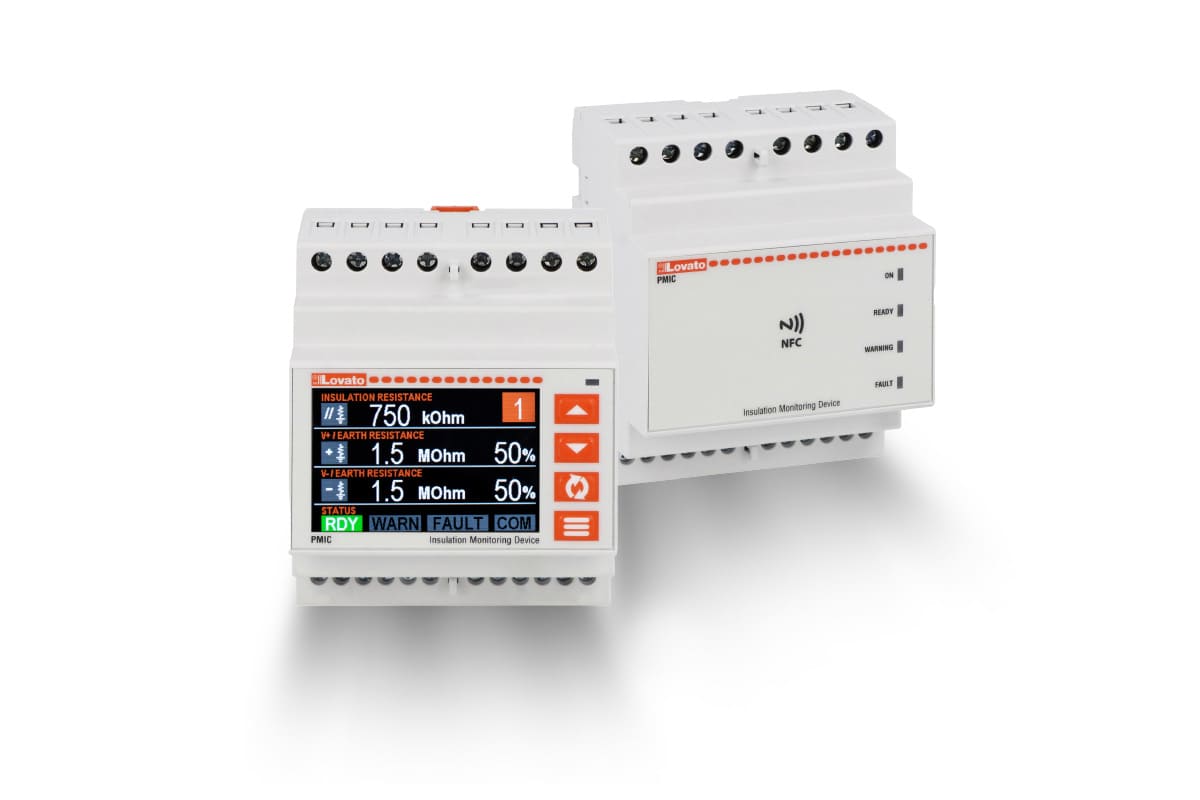
PMIC type insulation monitoring devices are available in versions with or without a colour graphic display:
- The versions with a display (PMIC type…) provide a clear and immediate view of the electrical measurements and status, with text available in 7 languages: English, Italian, Spanish, French, German, Portuguese and Polish. The colour graphic display allows users to view screens dedicated to electrical measurements (insulation resistance, system leakage capacitance and system voltage) and the status of the outputs via coloured graphic LEDs, which indicate whether the station is ready for charging or whether there are any insulation faults via warning and alarm thresholds.
- The versions without a display (PMIC…B type), on the other hand, feature 4 status LEDs on the front panel and NFC connectivity, enabling parameter configuration via Android and iOS devices using the LOVATO NFC app, which can be downloaded free of charge from the Google Play Store and the App Store. Settings can be password-protected to ensure maximum security against tampering, and the same configuration can be saved and copied to multiple devices of the same model in a matter of seconds directly from a smartphone.
All PMICs are housed in a compact modular enclosure comprising just 4 modules, which is one of the key strengths of these devices. Furthermore, they do not generate overheating, eliminating the need for safety clearances from adjacent devices. This offers a significant advantage in terms of installation flexibility and space optimisation within the electrical cabinet.
Single and dual channel versions are available, for monitoring one or two charging sockets respectively with just one device. The dual channel version offers significant advantages in terms of space optimisation, thanks to its ultra-compact 4-module housing, and simplified wiring. Furthermore, it allows both sockets to be monitored from a single point, with dedicated pages on the display clearly showing the readings and status of each channel.
PMICs monitor voltages of up to 1200VDC or 1500VDC depending on the model, making them suitable for both CCS (Combined Charging System) and MCS (Megawatt Charging System) installations.
All PMICs are powered by a 12–24 VDC auxiliary voltage and feature three SSR outputs per channel for status signals (ready to charge or insulation resistance below permitted warning or alarm thresholds) and one digital input per channel with a programmable function for testing, resetting or inhibition.
The integrated RS485 port also enables supervision, monitoring and parameter configuration via the Modbus-RTU protocol.
A further key feature is the wide operating temperature range, extending from -40 to +70°C, which ensures reliable performance even in extreme environmental conditions
The PMICs comply with the main international standards and are accompanied by official test reports issued by TÜV, certifying their compliance with industry standards, including IEC/EN 61557-8 (reference standard for IMDs), IEC/EN 61557-18 (standard for IMDs intended for DC charging stations, currently in draft form and due for publication in 2027) and IEC 61851-23 (reference standard for electric vehicle charging stations).

