
Safer DC EV charging starts with smarter insulation monitoring
With the expansion of the electric vehicle charging infrastructure and demand for faster and more powerful charging increases, the safety, reliability and operational continuity are more critical than ever.
High-power DC charging systems operate at significant voltages, with modern CCS and emerging Megawatt Charging System (MCS) installations pushing the demands on electrical infrastructure even further. In these environments, insulation degradation can develop gradually and often without any obvious warning.
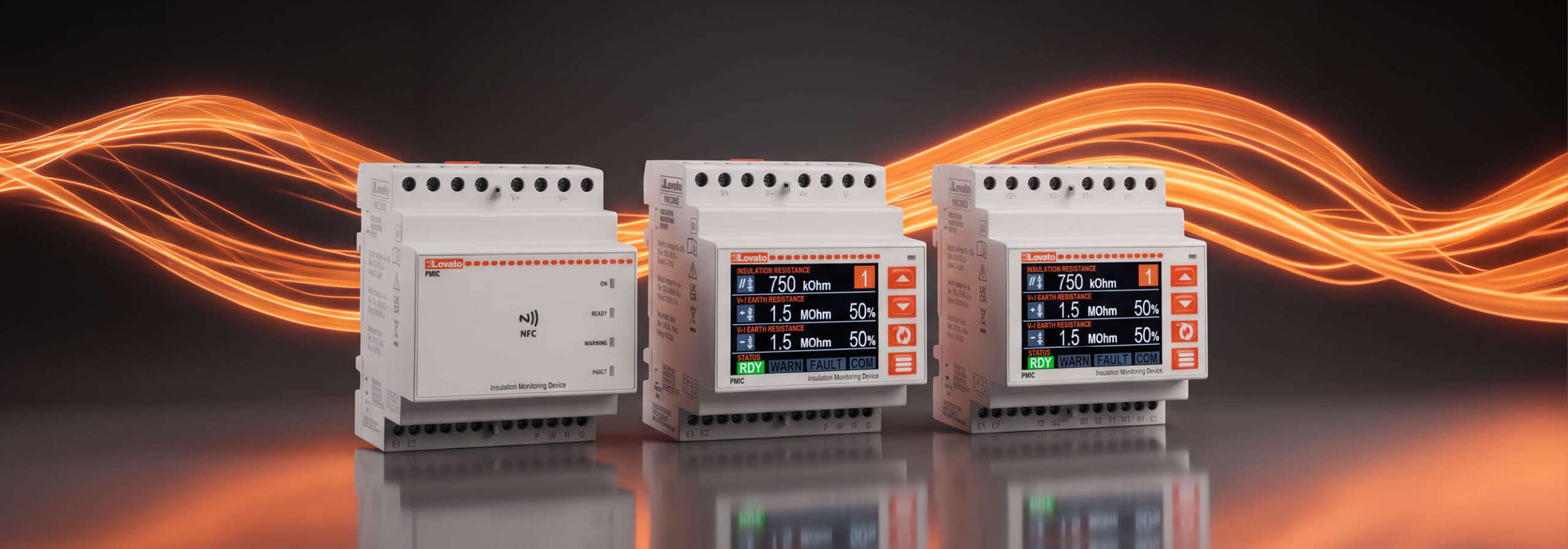
That is why LOVATO Electric is expanding its e-mobility portfolio with a new range of PMIC type Insulation Monitoring Devices (IMDs), specifically designed for DC electric vehicle charging stations.
By continuously monitoring insulation resistance in unearthed DC circuits, PMIC devices can detect insulation deterioration and earth faults at an early stage – helping charging infrastructure operators identify potential problems before they become dangerous, costly or disruptive.
–
Detect the problem before it becomes a failure
Electrical insulation failure can be a gradual issue that goes undetected.
Thermal stress from high currents can cause cable insulation to harden and crack. Humidity, salt spray and temperature fluctuations can penetrate connectors, while repeated bending, handling or crushing can cause mechanical damage. Dust, oils and other contaminants can also create unwanted conductive paths across electrical components.
The result is a potentially serious but often invisible deterioration in insulation performance.
In an unearthed IT system, the first earth fault may not interrupt operation. However, if a second fault occurs, the resulting conditions can create a serious risk to people, equipment and the charging system itself.
An insulation monitoring device provides an important additional layer of protection by continuously measuring insulation resistance and generating an alarm when the resistance falls below defined warning or alarm thresholds.
This gives operators and maintenance teams the opportunity to identify deterioration, investigate the cause and take preventative action before a developing fault becomes a critical failure
–
Built specifically for DC EV charging safety
LOVATO Electric’s new PMIC insulation monitoring devices have been developed specifically with the requirements of modern DC charging infrastructure in mind.
Available in models designed to monitor up to 1200VDC or 1500VDC, the PMIC range is suitable for both CCS (Combined Charging System) and MCS (Megawatt Charging System) installations. For 1500VDC applications, an integrated active balancing helper function helps stabilise the system during insulation monitoring. This improves measurement accuracy under variable operating conditions, supporting more reliable fault detection while helping to reduce false alarms.
For charging infrastructure manufacturers, installers and operators, this means a monitoring solution designed not just to detect faults, but to support the safety, reliability and availability of high-power DC charging infrastructure.

“As DC electric vehicle charging continues to evolve towards higher power and higher operating voltages, safety and reliability must evolve with it. Our new PMIC insulation monitoring devices provide charging infrastructure designers and operators with continuous visibility of insulation performance, helping them identify developing faults early and take preventative action.”
Nick Rhodes – National Sales Manager LOVATO Electric Ltd
–
One compact device. Flexible installation options.
Space inside an electrical cabinet is valuable, particularly as charging systems become more sophisticated.
One of the key advantages of the PMIC range is its ultra-compact four-module housing. Despite its extensive functionality, the device occupies minimal cabinet space and does not generate overheating, removing the need for safety clearances from adjacent devices.
That creates greater flexibility when designing electrical cabinets and can simplify installation where space is at a premium.
The range also includes single- and dual- channel versions. A single-channel PMIC can monitor one charging socket, while the dual-channel version can monitor two sockets from a single device. This can significantly reduce component count, simplify wiring and optimise cabinet space.
For models equipped with a display, dedicated screens provide clear visibility of the readings and status of each channel.
–
Clear information when you need it
Understanding what is happening inside a charging system is critical when responding to an alarm or carrying out preventative maintenance.
The PMIC versions with a colour graphic display provide an immediate view of key electrical measurements, including:
- Insulation resistance
- System leakage capacitance
- System voltage
- Output status
- Warning and alarm condition
The display uses clear graphical indicators to show whether the charging station is ready for charging or whether an insulation fault has been detected.
For applications where a display is not required, the PMIC…B versions provide four front-panel status LEDs alongside NFC connectivity.
Using the free LOVATO NFC app for Android and iOS devices, engineers can configure parameters directly from a smartphone or tablet. Settings can also be password protected and saved, allowing the same configuration to be rapidly copied to multiple devices of the same model.
–
Designed for smarter maintenance
Continuous insulation monitoring is not simply about reacting to faults.
It can also support a more proactive approach to maintenance.
By identifying changes in insulation resistance before they develop into a serious failure, operators can investigate potential issues and plan maintenance interventions around their operational requirements.
This can help reduce unexpected downtime, improve maintenance planning and support the long-term reliability of EV charging infrastructure.
The PMIC range also incorporates an RS485 communication port, enabling supervision, monitoring and parameter configuration through the Modbus-RTU protocol.
Each channel features three SSR outputs for status signals, including ready-to- charge and warning/alarm conditions, plus a programmable digital input that can be used for functions such as testing, resetting or inhibition
–
Ready for demanding charging environments
DC charging infrastructure isn’t always installed in controlled indoor environments.
Charging stations can be exposed to significant temperature fluctuations and harsh environmental conditions, making component reliability essential.
LOVATO Electric’s PMIC devices are designed to operate across a wide temperature range of -40°C to +70°C, supporting reliable operation in demanding environments.
This combination of compact installation, continuous monitoring, communication capabilities and wide operating temperature range makes the PMIC range a flexible solution for the evolving requirements of DC EV charging infrastructure.
–
Safety backed by recognised standard
When specifying safety-critical equipment, performance needs to be backed by appropriate standards and testing.
The LOVATO Electric PMIC range complies with key international standards relevant to insulation monitoring and EV charging, including IEC/EN 61557-8, the reference standard for insulation monitoring devices.
The devices also address IEC/EN 61557- 18, the standard specifically relating to IMDs for DC charging stations, currently in draft form and due for publication in 2027, as well as IEC 61851-23, the reference standard for DC electric vehicle charging systems.
Official test reports issued by TÜV provide additional independent certification of compliance.
A smarter approach to EV charging infrastructure safety
As EV charging moves towards higher power, higher voltages and greater levels of infrastructure utilisation, the consequences of an undetected electrical fault become increasingly significant.
Continuous insulation monitoring provides an opportunity to move from reactive protection to proactive safety.
LOVATO Electric’s new PMIC insulation monitoring devices combine continuous monitoring, early fault detection, compact installation, flexible communication and configuration options in a solution designed specifically for DC EV charging stations. Whether you are developing new charging infrastructure, designing electrical cabinets or looking to improve the safety and reliability of existing systems, PMIC provides a practical way to monitor insulation performance continuously and identify potential problems before they become critical.
–
Looking for a safer approach to DC EV charging?
If you are designing, specifying or maintaining DC EV charging stations, LOVATO UK’s PMIC insulation monitoring devices can provide an additional layer of protection while supporting greater visibility, preventative maintenance and operational continuity. Talk to the LOVATO UK team about the PMIC range and find the right insulation monitoring solution for your EV charging application.

